


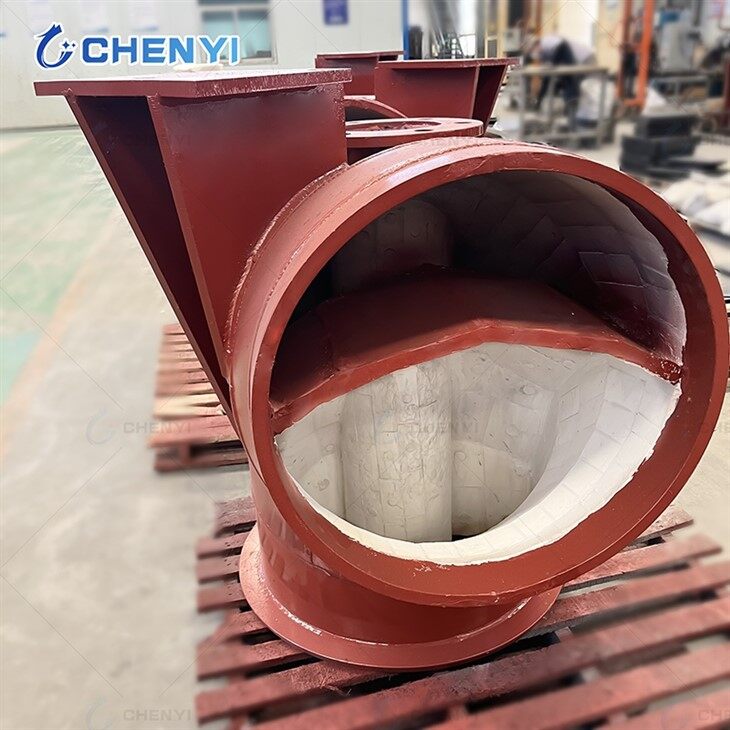


Large Diameter Alumina Ceramic Lined Y-Pieces for Mining Coal Industry

Structural composition: usually composed of ceramic(alumina or silicon carbide) layers, transition layers, and steel layers. The ceramic layer is located inside and directly in contact with the conveyed medium; The transition layer is used to connect the ceramic layer and the steel layer, playing a role in buffering and enhancing the bonding force; The steel layer provides the strength and toughness of the pipe fittings, ensuring the overall structural stability of the pipe fittings.
Ceramic Lined Y-Pieces
| Alumina (Al₂O₃),Silicon carbide(SISIC or RBSC) or Zirconia (ZrO₂) linings extend lifespan 10–20x vs.bare steel. | |
| Engineered for high-velocity particle collisions. | |
| Inert ceramics resist acids, alkalis, and oxidation. | |
| Reduces turbulence and wear hotspots. | |
| Designed for 30℃, 45℃, 60℃, or 90℃ branch angles. |
Ceramic Lined Y-Pieces
| Base Pipe Carbon steel, Stainless steel (304/316), or Alloy steel. | |
| 92% Al₂O₃ (standard), 95% Al₂O₃ (premium), ZTA/ZrO₂/SiC (extreme wear). | |
| Vulcanized rubber-backed tiles, sintered ceramics, or epoxy adhesives. |
| 5–20 mm (customizable). | |
| (Mohs) 9 (Al₂O₃), 9.5 (SiC). | |
| Max. Temp. | 400℃ (rubber-backed), 800℃ (sintered). |
| Up to 25 bar (higher on request). | |
| 2" to 36" (DN50–DN900). |
✔ Mining & Slurry Transport: Ore, tailings, and sand pipelines.
✔ Coal & Power Plants: Ash handling, fly ash conveying.
✔ Cement Industry: Raw meal, clinker, and kiln feed lines.
✔ Chemical Processing: Corrosive abrasive media (e.g., alumina slurry).
Best Choice When: • Handling sharp, high-abrasion materials (e.g., iron ore, silica sand). • Long-term cost savings outweigh upfront investment.
Branch Angle: 30℃–90℃ (affects wear pattern).
Flow Velocity: >3 m/s requires thicker ceramics.
Installation: Flanged or welded connections; ensure proper alignment.
Self propagating high-temperature synthesis (SHS): Utilizing the exothermic reaction between metal oxides and raw materials such as aluminum powder, high temperatures are generated instantly, causing the reaction products to melt and form a ceramic layer on the inner wall of the steel pipe. If the reaction Fe ₂ O3+2Al=2Fe+Al ₂ O3, under the action of centrifugal force, the generated molten alumina is uniformly spread on the inner wall of the steel pipe, and then cooled and solidified to form a ceramic layer.
: ceramic powder is loaded into a mold, compacted and formed under high pressure, and then subjected to high-temperature sintering and other processes to produce ceramic lined pipe fittings. This method can make the density of ceramic lining uniform and the performance stable.
* Provide 7 * 24-hour service. Feel free to contact us by phone, email, instant messaging and social media.
* After receiving your inquiry, reply within 8 hours, and provide the price plan within 24 hours.
and QC personnel.
* In the cost, production, inspection, packaging, delivery and other aspects to provide a full range of intimate services.
* Provides professional support and assurance at all stages of sales.


